They often say that the Scots are a canny lot with money, according to John Curtice in today's Scottish Edition of the Times* it seems that stretches to Government money too.
He looks at the two YouGov Scottish opinion polls the first of which during the first week of the campaign had the SNP down at 21% the other taken from Wednesday to Friday last week had them at 20% only just ahead of the Lib Dems. In his conclusions he points out that the SNP malaise is not so much because of the Lib Dem surge nationally nor because of the exclusion from the debates as they were already down before the debate and only sank slightly.
What he does point out is another finding from that second sampling. The Nats slogan of "More Nats less tax" isn't cutting the mustard with economically savvy Scots. Only 25% agreed with the proposition while and overwhelming 52% disagreed. Just like their claim that they are listening to Scots on independence it appears that they have not listened to Scots about how to deal with the structural deficit.
The Scots know that without pruning of Government services we cannot hope to emerge strong from this recession.
* Cannot find an online copy yet.
Showing posts with label recession. Show all posts
Showing posts with label recession. Show all posts
Tuesday, April 20, 2010


Friday, February 19, 2010
Fasten Your Seatbelts: Economy Facing Turbulence

Just when Labour thought they had pulled off a feather soft landing it appears that the UK economy is still up in the air and is still facing turbulence
A number of indicators are suggesting that the possibility of a double dip is even stronger that was initially feared. The oh, so small recovery in December, may end up being also oh, so short lived. So what are the figures that are causing concern.
- A £4.3bn deficit in public sector borrowing - first time on record Treasury ahs not recorded a January surplus
- 1.8 per cent drop in sales volume from December to January - three times worse than expectations worse month since June 2008.
- Sale on household goods down 13.4% fastest drop since 1988
- Fuel sales down 11.1% as a result of the poor weather.
Of course VAT going up in January may well have meant that the recovery in December was spurred by people buying stuff before the price went up. Looking at the household good which are often a January sale stalwart this may well have been the case. The possibility may have been that the recovery in December may only have been a blip ahead of the Governments own tax proposals taking effect. It might just be that the recovery hadn't really started, but people were making the most of the last month of 15% VAT, while this was still a stimulus.
If we were in an airplane no doubt the chief steward would come on the tannoy telling us to refasten our seatbelts as we will be experiencing turbulence ahead. Sixty of the wise passengers, who have a fair idea how to fly this plane have passed a note to the chief steward, a man called Darling, agreeing with his decision to delay Government spending cuts until 2011. The concern it that there may be a change of aircrew mid flight, that may not heed their memo and head straight into the storm.
The potential replacement crew's chief Steward, George Osborne, is saying that it is a lack of a logged flight plan to get us out of this mess that is losing the confidence of the passengers and indeed others who may be looking to invest in the airline. A former close follower of that band of sixty with more air hours than George when it comes to such decision, Vince Cable, has said that yes there needs to be a clear plan to deal with the deficit, but also considers that when to make to begin to make those cuts should be determined on the strength of the economy in a years time. Indeed he is itching to get on that tannoy to say:
"We've got to look at what is happening in the real economy and not be based on political dogma."
The replacement crew seem to have been on an easier that is sufficient simulator, to get ready to take over, and still seem to be blinkered by that rather than what is going on around them. Possibly spending too much time in first class and not enough checking what is going on in coach.
Friday, February 12, 2010
The Real Test for Euro Membership

When I was a student we still only had the exchange rate mechanism of the European Monetary System. But being the great fan of Sci-fi that I was my dissertation looked to the future and a European currency, I pointed out that the real test for such unity wouldn't come in the good times but would come in the bad, then I said it would depend how Germany, France, Italy and the UK (yeah I was an optimist) reacted when times were tough and part of the zone needed help.
Well it may be almost twenty years later but such a crossroads has been arrived at. Or to be precise we've been standing at that crossroads for sometime waiting to stride off confidently but now we're about ready to head off, we're not sure what to do.
The issue of course is Greece.
The EU leaders have said they are prepared to deliver a rescue package for the Greek economy and to shore up the integrity of the Eurozone, they just haven't announced the details yet. But at the end of over a year of such support for other EU economies some nations are not happy. This morning on the news I heard mention of some in Germany being up in arms and saying enough is enough and saying they would be better returning to the Deutchsemark.
Of course there are criteria for entering the Eurozone these have to be met before admission is allowed. These are clearly laid out to EU member states that wish to enter. The issue of expulsion isn't so clear, but there is talk that some wish to remove Greece. Indeed Phoebus Athanassiou writes in a European Central Bank working paper that such a move in almost certainly illegal, there is no exit criteria only for entry.
Of course the reason for setting up the Euro was to allow competitive advantage, economic stability and smooth out the dips that any one Euro member would have against the world economy. The larger nations would benefit from the security if their prices across the zone and the ability to plan within the world. The smaller nations would have the security blanket of the more established nations, benefiting from the economy of scale to help them develop. That is all well and good when times are good, even when they are stagnated, but not when they are dipping sharply.
There is the option of voluntary withdrawal a country then could in theory devalue its currency to improve competitiveness and to set its own interest rates.But either expulsion or withdrawal would not be an easy option. Don't forget as well as Greece, Ireland, Spain and Portugal are also finding it tough just now.
The Options
- Expulsion - verges on illegality, plus needs to create a new European Community minus the expelled member.
- Voluntary withdrawal - at this stage almost impossible to withdraw from all the institutions needed to be in Eurozone without withdrawing from EU itself.
- Withdrawal keeping Euro - Some states outside the EU currently operate the Euro so would be possible to withdraw, revalue and keep Euro at new rate.
The thing is that the Eurozone countries have to be in this together, that was the agreement, that was the commitment that was made. Like a marriage it is for sickness or in health and divorce is a whole lot messier with so much involved.
Sunday, February 07, 2010
Things Brown has Been Absolutely Certain About
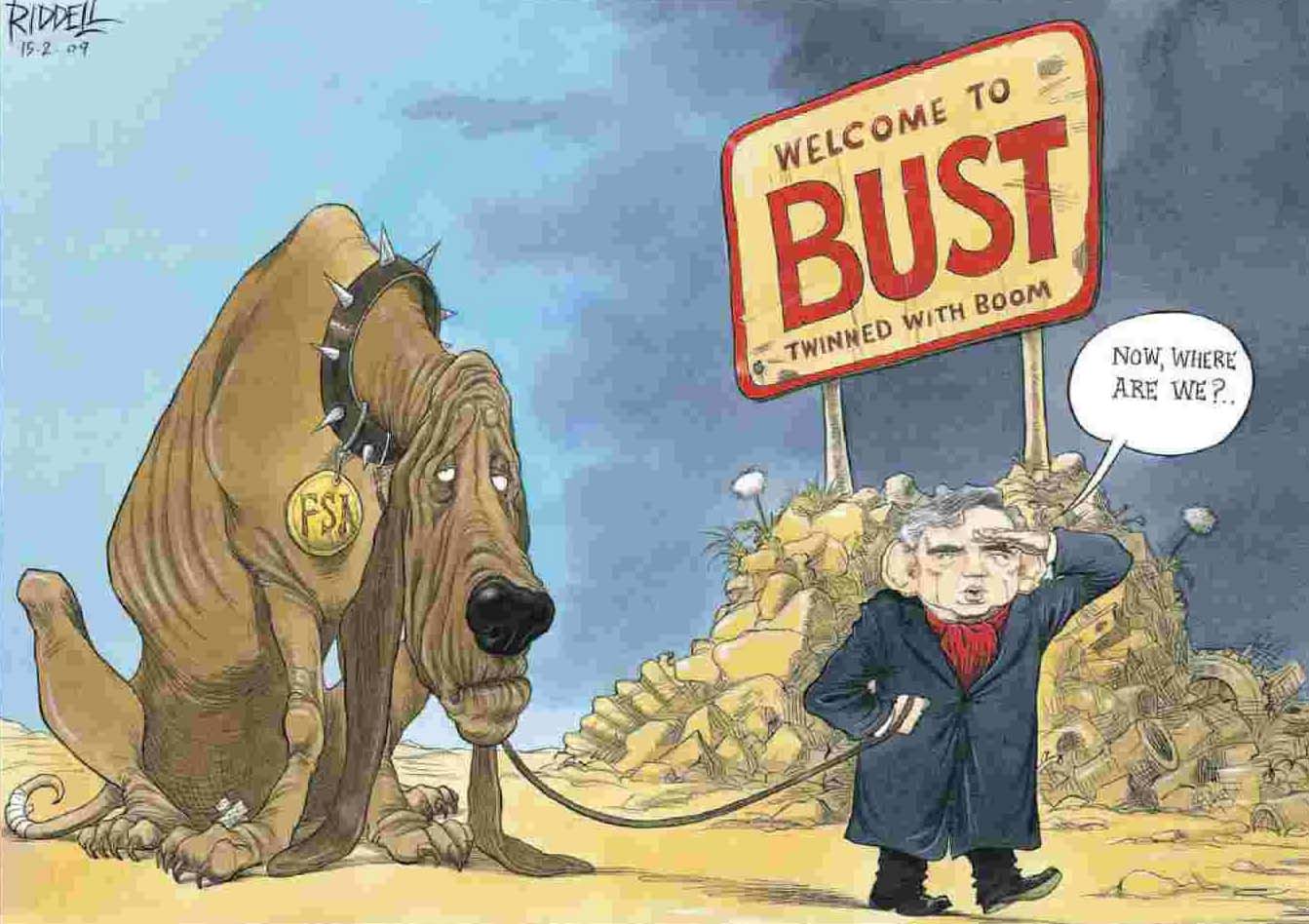
Today in the Observer Gordon Brown says:
"I'm not complacent, but Labour can still win it. I'm absolutely sure of that."
This is the same man who declared in September 1999:
"And I say to Conference and the country, we will never return to the days of Tory boom - bust."
What never? What absolutely sure?
I think Gordon doth use superlatives too much and too glibbly.
Wednesday, December 16, 2009
Need to Get the Banks Lending Again
Figures released yesterday showed that the number of new business start ups in Scotland are down 16% on the same time last year. In Q3 2008 there were 4,598 in 2009 this was down to 3,861.
Speaking on this issue Alistair Carmichael MP said:
There have been affects in and around West Lothian of how hard businesses have found it to secure capital from the lenders to keep afloat. There are more empty retail and production premises around now than in the lead up to last Christmas.
Speaking to some of the local retailers in Bathgate they have said that yes the turnover is affected as people are less willing to part with their money. But they are also finding it harder to get access to money from the bank to help either tide them over tough times or to expand stock levels or opportunities.
The two main banks that they use are the Scottish banks RBS and HBoS which are both owned by the people. The Chancellor has said the banks need to start acting like banks again, that means lending money to business to help aid the recovery. I know that Vince Cable is lashing out at the bingo hall banking practices that led to this mess, but Vince knows that there has to be some level of risk in lending money to business to ease our economy out of recession. The banks are not yet doing so, and so it is that new businesses are not able to get going to replace the ones that sadly have gone by the wayside.
Speaking on this issue Alistair Carmichael MP said:
"These figures show just how hard the recession is hitting Scotland’s small business sector.
"Labour has effectively nationalised two of Scotland’s largest banks, but they have done little or nothing to get them lending again. This has left businesses struggling without the credit they need.
"Gordon Brown and Alistair Darling should be standing up to the bankers who did so much to cause the current recession. But instead they are letting them get away with massive bonuses while they leave Scotland’s small business sector high and dry."
There have been affects in and around West Lothian of how hard businesses have found it to secure capital from the lenders to keep afloat. There are more empty retail and production premises around now than in the lead up to last Christmas.
Speaking to some of the local retailers in Bathgate they have said that yes the turnover is affected as people are less willing to part with their money. But they are also finding it harder to get access to money from the bank to help either tide them over tough times or to expand stock levels or opportunities.
The two main banks that they use are the Scottish banks RBS and HBoS which are both owned by the people. The Chancellor has said the banks need to start acting like banks again, that means lending money to business to help aid the recovery. I know that Vince Cable is lashing out at the bingo hall banking practices that led to this mess, but Vince knows that there has to be some level of risk in lending money to business to ease our economy out of recession. The banks are not yet doing so, and so it is that new businesses are not able to get going to replace the ones that sadly have gone by the wayside.
Thursday, December 03, 2009
RBS Board Adopting SNP Tactics

The SNP tactic leading into budgets and was (until it actually happened) the same about votes of confidence in their ministers to resign en masse and cause a new election they thought. Well it appears that the Royal Bank of Scotland board are to take the same approach over their bonuses.
The bank is looking to pay £1.5bn* in bonuses to its investment arm up from £900m last year. The board says it needs to pay this money to keep its top personnel with them and to keep them incentivised. Saying they need to act in the interests of all shareholders, not just the major one, a bit much after how those same shareholders were treated in recent years. Personally many of the rest of us have taking lower pay rises, reductions, loss of overtime payments, loss of bonuses with the only incentive to keep a job during the financial crisis. However, the issue does raise the issue of what type of bank the RBS is.
The Government bailed out the bank not to protect the investment arm but to protect the banking interests of the ordinary clients of the banks and their savings and banking facilities. These had been put at risk by that investment arm and its casino banking practices. Lib Dem Treasury Spokesman Vince Cable has been one of the most vocal proponents for breaking up the banking sector so that the high street banking sector that is all that most of us every have direct concerns about is separate from the speculative nature of the investment banks.
I recall when I first started studying economics the two were discussed totally separately, but soon after banking regulation was relaxed to allow both aspects to be carried out by the same company. However, maybe it is time for the Government to go back to those earlier principle to shore up confidence in our high street banks, after all you don't find an insurance company operating in the same premises as a bookmaker.
However, the issue with the bonuses is that the banks and the bankers were bailed out at tax payers expense and the government is going to look to get the taxpayers money back at some point. To spend £1.5bn of it on bonuses to staff, especially when many of those who bank with them are still struggling to make ends meet is lording it over everyone. Indeed if any other company director in any other line of business were to get a bail out from someone taking over 70% of the business in an interim agreement the profit would generally go to paying back that investor, even their own share of the profits to get out of the control quicker.
*This equates to 25% of the £6bn profit made by the investment arm of the bank this year.
Tuesday, November 24, 2009
Troubled Borders
Almost a year ago on the 26th November last year, Woolworths went into administration
Today there is more potentially sad news for the High Street, today there is the first sign that Borders, the bookseller, is faltering. Their website has stopped taking new orders and there are rumours that they do not have enough money to make it through to Christmas.
Borders of course suffers doubly, they are dwarfed as far as High Street bookselling goes by Waterstones' 303 stores to 45. Online they are obviously small fry compared to Waterstones. Of course unlike MFI that also disappeared around the time of Woolworths last year there is no disparity in product. The books that they sell are identical in every way to those of Waterstones or Amazon or any other bookseller of course. What may be their undoing in the matter of economies of scale. They are a smaller purchaser, and therefore seller of the same items and therefore may not be able to get the same deals to undercut in price the other stores.
Of course my most accessible Borders store is in Glasgow, without a car Fort Kinnaird in Edinburgh is bit of a trek, especially when there are three Waterstones either on or close to Princes Street, even Blackstones isn't that difficult to get to from the city centre. Plus I also have another Waterstones in Livingston and one at the Gyle close to where I work. So yes there is a case of near Tesco-like saturation of the local market of the biggest bookseller in the UK.
It may well be a sad day for Borders, and I shall miss being able to browse their shelves when I do get a chance, as every so often I do find something different there, like you do when you visit somewhere that is laid out different from your normal shopping location style.
Today there is more potentially sad news for the High Street, today there is the first sign that Borders, the bookseller, is faltering. Their website has stopped taking new orders and there are rumours that they do not have enough money to make it through to Christmas.
Borders of course suffers doubly, they are dwarfed as far as High Street bookselling goes by Waterstones' 303 stores to 45. Online they are obviously small fry compared to Waterstones. Of course unlike MFI that also disappeared around the time of Woolworths last year there is no disparity in product. The books that they sell are identical in every way to those of Waterstones or Amazon or any other bookseller of course. What may be their undoing in the matter of economies of scale. They are a smaller purchaser, and therefore seller of the same items and therefore may not be able to get the same deals to undercut in price the other stores.
Of course my most accessible Borders store is in Glasgow, without a car Fort Kinnaird in Edinburgh is bit of a trek, especially when there are three Waterstones either on or close to Princes Street, even Blackstones isn't that difficult to get to from the city centre. Plus I also have another Waterstones in Livingston and one at the Gyle close to where I work. So yes there is a case of near Tesco-like saturation of the local market of the biggest bookseller in the UK.
It may well be a sad day for Borders, and I shall miss being able to browse their shelves when I do get a chance, as every so often I do find something different there, like you do when you visit somewhere that is laid out different from your normal shopping location style.
Tuesday, November 17, 2009
Dave Leads by Chasing Down a Bolted Bandwagon
The man widely tipped as the next Prime Minister has yet again shown his lack of 'leadership' by following Nick Clegg's attack on the Labour publicising Queen's speech that I gave an alternative for yesterday.
Mind you Cameron's posturing is also just that, he says "What we need is radicalism and the Conservatives have proved that we are the only party to possess it."His radicalism is aimed at conquering the recession, social problems and the political system.
However, look at some of that radicalism, on the national debt, they are revisiting the child credit on the highest paid, good so are the Lib Dems. Yet they are also looking to reward the highest paid with perks in inheritance tax. They are looking to freeze public sector pay, the Lib Dems have also promised that for the top end jobs. The conservatives have promised to do so for all but the lowest paid 1 million, that is all the public sector workers paid under £18,000. It may be radical but is hardly improving the lot of social problems, especially for the low paid public servants who have to work in London.
On our broken society Cameron admits that his triumvirate teenage pregnancy, addiction and crime won't be fixed overnight. Strange that he is attacking Labour of bringing things they won't have time to achieve by offering up an alternative that is also unachievable. However, they are saying that any suitably qualified organisation can set up a new school anywhere they wished. Those that mean Ronald McDonald or Disney High Schools, after all those these multinationals have educational programmes within their corporate structure, indeed for that matter so do most multi-nationals.
If these qualified organisations can set up a school anywhere they want, surely won't they be looking for where they may most benefit to the organisation? Surely these will not be set up where the new school is most needed. Yes Cameron then mentions his pupil premium to encourage schools to take on pupils from less advantaged backgrounds, but what if these new schools are getting set up too far away to be of use?
As for Parliamentary reform he says he will cut ministers’ salaries by 5 per cent, scrap the perks and subsidies of parliamentary life, reign in the quango state and give power to local government, communities, families and individuals.
Ok the first is in line with Public Service restructuring the Lib Dems have proposed. But just what does Cameron mean by the perks and subsidies of parliamentary life? How far reaching those that stretch into necessary expenses to ensure that being a Member of Parliament isn't just a job for the well off, as it was in the 19th century? We've already seen that some of their radical reforms will hurt aspirant MPs from less well off situations, potentially losing a level of representative and experience to the House.
Unlike Nick who yesterday gave a number of concrete proposals to make real change is giving power to the people Cameron is (as the Tories have so long) being vague of the specifics. You really must wonder just when anything concrete, and fair, will actually come from the Tories rather than homilies and aspirational words on this.
Mind you Cameron's posturing is also just that, he says "What we need is radicalism and the Conservatives have proved that we are the only party to possess it."His radicalism is aimed at conquering the recession, social problems and the political system.
However, look at some of that radicalism, on the national debt, they are revisiting the child credit on the highest paid, good so are the Lib Dems. Yet they are also looking to reward the highest paid with perks in inheritance tax. They are looking to freeze public sector pay, the Lib Dems have also promised that for the top end jobs. The conservatives have promised to do so for all but the lowest paid 1 million, that is all the public sector workers paid under £18,000. It may be radical but is hardly improving the lot of social problems, especially for the low paid public servants who have to work in London.
On our broken society Cameron admits that his triumvirate teenage pregnancy, addiction and crime won't be fixed overnight. Strange that he is attacking Labour of bringing things they won't have time to achieve by offering up an alternative that is also unachievable. However, they are saying that any suitably qualified organisation can set up a new school anywhere they wished. Those that mean Ronald McDonald or Disney High Schools, after all those these multinationals have educational programmes within their corporate structure, indeed for that matter so do most multi-nationals.
If these qualified organisations can set up a school anywhere they want, surely won't they be looking for where they may most benefit to the organisation? Surely these will not be set up where the new school is most needed. Yes Cameron then mentions his pupil premium to encourage schools to take on pupils from less advantaged backgrounds, but what if these new schools are getting set up too far away to be of use?
As for Parliamentary reform he says he will cut ministers’ salaries by 5 per cent, scrap the perks and subsidies of parliamentary life, reign in the quango state and give power to local government, communities, families and individuals.
Ok the first is in line with Public Service restructuring the Lib Dems have proposed. But just what does Cameron mean by the perks and subsidies of parliamentary life? How far reaching those that stretch into necessary expenses to ensure that being a Member of Parliament isn't just a job for the well off, as it was in the 19th century? We've already seen that some of their radical reforms will hurt aspirant MPs from less well off situations, potentially losing a level of representative and experience to the House.
Unlike Nick who yesterday gave a number of concrete proposals to make real change is giving power to the people Cameron is (as the Tories have so long) being vague of the specifics. You really must wonder just when anything concrete, and fair, will actually come from the Tories rather than homilies and aspirational words on this.
Thursday, October 15, 2009
What Alex Said and What he Missed Out
Speaking today in Inverness at the start of the SNP conference Alex Salmond tried to do a Gordon Brown and list some achievements. Here is what he said, in brackets is what he missed out.
"Today, I am proud to be addressing you as First Minister on behalf of a successful and popular SNP administration – delivering for the people of Scotland.
"Scotland is a great nation, and is even better with the policies we have already introduced in our first two years – freezing the Council Tax (but he promised to Axe it and replace with a Local Income Tax)), recruiting 1,000 more police (the actual promise was for 1,000 extra on the street, not yet achieved), saving A&E units, restoring free education (they actually promised to dump student debt and have yet to tackle that), and moving quickly in the downturn to implement an economic recovery plan that is protecting 15,000 jobs."
"Admittedly the last point was trying to claim credit for dealing with the unexpected, however 8,500 construction jobs have been lost in Scotland this year may have something to do with the failure to match school building pledges brick for brick. Only schools started by the last administration or through Local authority funding have been completed, none have been started as a result of Parliament funding as promised. Unemployment has also more than doubled in Scotland's rural areas. 700 jobs went at Diageo's bottling plant in Motherwell due to SNP bickering. 700 jobs at the Royal Bank of Scotland, 500 more through Lloyds subsiduaries, 300 redundacnies at Scottish Universities, 850 at Hewlett Packard in Erskine. Even Skills Development Scotland an initiative that should be helping those out of work get back to work laid off 160.
Here in West Lothian 500 jobs are going at Bausch and Lomb’s plant in Livingston due to the SNP's failure to maintain the areas Regional Selective Assistance status. 58 went with the closure of the SEH Europe plant in Livingston, 60 at Russell Europe's distribution plant in Bathgate, HBoS cut many jobs from its IT base in Livingston, 140 Jobs at Sun Microsystems in Linlithgow.
Now I've not been keeping count and I could go on, but I reckon I'm pretty sure I'm over 15,000 right there, all with in the last 12 months or so.
"Today, I am proud to be addressing you as First Minister on behalf of a successful and popular SNP administration – delivering for the people of Scotland.
"Scotland is a great nation, and is even better with the policies we have already introduced in our first two years – freezing the Council Tax (but he promised to Axe it and replace with a Local Income Tax)), recruiting 1,000 more police (the actual promise was for 1,000 extra on the street, not yet achieved), saving A&E units, restoring free education (they actually promised to dump student debt and have yet to tackle that), and moving quickly in the downturn to implement an economic recovery plan that is protecting 15,000 jobs."
"Admittedly the last point was trying to claim credit for dealing with the unexpected, however 8,500 construction jobs have been lost in Scotland this year may have something to do with the failure to match school building pledges brick for brick. Only schools started by the last administration or through Local authority funding have been completed, none have been started as a result of Parliament funding as promised. Unemployment has also more than doubled in Scotland's rural areas. 700 jobs went at Diageo's bottling plant in Motherwell due to SNP bickering. 700 jobs at the Royal Bank of Scotland, 500 more through Lloyds subsiduaries, 300 redundacnies at Scottish Universities, 850 at Hewlett Packard in Erskine. Even Skills Development Scotland an initiative that should be helping those out of work get back to work laid off 160.
Here in West Lothian 500 jobs are going at Bausch and Lomb’s plant in Livingston due to the SNP's failure to maintain the areas Regional Selective Assistance status. 58 went with the closure of the SEH Europe plant in Livingston, 60 at Russell Europe's distribution plant in Bathgate, HBoS cut many jobs from its IT base in Livingston, 140 Jobs at Sun Microsystems in Linlithgow.
Now I've not been keeping count and I could go on, but I reckon I'm pretty sure I'm over 15,000 right there, all with in the last 12 months or so.
Friday, September 04, 2009
It's Friday, It's Doughnut Day
Every Friday at work is Doughnut day (fruit alternatives were campaigned for and are available) so therefore this cartoon from Peter Brookes in today's Times, brought a timely smile to my face.
Although just when will the UK be last to pull ourselves out of the economic hole?

Although just when will the UK be last to pull ourselves out of the economic hole?

Thursday, April 23, 2009
The 3.5% Growth Myth 2: The IMF Deception
The below is exactly what Alistair Darling said about economic growth in his Budget speech yesterday. I make no apologies for quoting it at length as the whole point I wish to draw out of it is one of contextualisation. I've added parenthesis to draw out the key elements.
He repeatedly refers the IMF predictions from their report for yesterday, it adds gravitas does it not? You think that he is drawing from a wealth of experience to make his predictions for the future. What did the IMF figures say 2009 -4.1% and 2019 -0.4%. The only bit of fact that Darling does extract from the IMF figures is that the 2009 figure is better than the Eurozone -4.2%, Japan -6.2%, and Germany of -5.6%. Of course he fails to mention USA who take all the blame for this recession only dipping by 2.8% and Canada most closely aligned at -2.5%.
So therefore who are these other independent forecasts that he speaks off. Having reviewed all of yesterdays papers the most optimistic forecast I was for 2010 was +0.5%, the Times had 0.3% but suggested Darling would say 1%. Where oh where has he squeezed the extra 0.25% out of what was even deemed an optimistic prediction yesterday.
Maybe be he has discovered the golden fleece, or sold the Downing Street cat to a stranger in the street from some beans which are are growing very well in the garden of Number 11. Fee fi fo fum I smell the lie of an Darling tongue.
"Mr Deputy Speaker, the UK went into this global recession with employment at an all-time high, inflation, public debt and interest rates at low levels. But no country can insulate itself from this worldwide downturn. The position here, as in every country, deteriorated in the autumn. In the last few months, world trade fell at the sharpest rate since 1945. As an open economy, the world's sixth biggest exporter of goods and the second largest exporter of services, we are affected by the collapse in demand in other countries. The unexpected severity of the recession has led the IMF to
downgrade its own forecasts for the world economy three times since
October. We, as well as other countries as diverse as Japan and France, India
and the US, have reduced our growth estimates.
"Mr Deputy Speaker, the UK economy contracted by 1.6 per cent in the last
quarter of 2008. For the first quarter of this year, I expect the economy will again contract by a similar amount. And my forecast for GDP growth for the year as a whole will be –3 ½ per cent – in line with other independent forecasts. But
because of our underlying strength, the measures we are taking, domestically and internationally, I expect to see growth resume towards the end of the year.
"The IMF forecasts published today confirm the problems that all countries will face this year. But they also show that the British economy will suffer less than Germany, less than Japan, less than Italy, and less than the euro area as a whole this year. The British economy is diverse, flexible and resilient – which is why we can be confident in recovery. Next year, because of the pick up in world demand, the continuing benefit of lower prices, and the substantial recovery measures put in place, I am forecasting growth of 1 ¼ per cent in 2010.
"In future, the sources of our growth will be more varied – and we need to ensure we play to our country's strengths. It will increasingly come from an expansion in investment by businesses in the industries of the future, such as low-carbon, advanced manufacturing and communications. These industries,
together, are as important to the British economy as the financial services
sector. That is why it has been so important that we have increased investment in Britain's science base by 88 per cent in real terms over the last ten years.
Growth will also be driven by the opportunities to export as the global economy doubles in size in the next two decades. From 2011, I am forecasting that the economy will continue to recover, with growth of 3 ½ per cent from then on."
He repeatedly refers the IMF predictions from their report for yesterday, it adds gravitas does it not? You think that he is drawing from a wealth of experience to make his predictions for the future. What did the IMF figures say 2009 -4.1% and 2019 -0.4%. The only bit of fact that Darling does extract from the IMF figures is that the 2009 figure is better than the Eurozone -4.2%, Japan -6.2%, and Germany of -5.6%. Of course he fails to mention USA who take all the blame for this recession only dipping by 2.8% and Canada most closely aligned at -2.5%.
So therefore who are these other independent forecasts that he speaks off. Having reviewed all of yesterdays papers the most optimistic forecast I was for 2010 was +0.5%, the Times had 0.3% but suggested Darling would say 1%. Where oh where has he squeezed the extra 0.25% out of what was even deemed an optimistic prediction yesterday.
Maybe be he has discovered the golden fleece, or sold the Downing Street cat to a stranger in the street from some beans which are are growing very well in the garden of Number 11. Fee fi fo fum I smell the lie of an Darling tongue.
Wednesday, April 22, 2009
The 3.5% Growth Myth
I've been trying to find historical data that would back up Alistair Darling and Yvette Cooper's claim that we can bounce back to a sustained level of 3.5% growth. What I did find was the OECD figures back to 1970. Firstly though lets look at the figures since Labour came to power.
 Even with the dot com boom coinciding with the start of that period of growth 3,5% was never sustainable. Something that Darling seemed to indicate in his budget speech earlier. Indeed 2.5% seems to have been closer to the mean over this period of sustained growth. Taking out the first 3 1/2 years that coincided with that boom it was actually 2.58%. Over the first 10 years of Labour it averaged 2.95%.
However, the claim I heard from Yvette Cooper on Channel 4 News when I finally got in through the door was that after periods of recession we have often bounced back very strong. Looking at the data yes we have had times of recovery to 3.5% or above, but maybe for only a year or two. Darling this afternoon seemed to promise at least 4 years, if not more, of that level of growth. Also the other times that the woes of the world took our growth down we came out of it on the worldwide recovery to that level if it happened. It was outwith the control of the man carrying the Gladstone dispatch box.
Of course one country is sustaining that sort of level of economic growth, China. So maybe that is why the civil liberties in this country are being eroded so much we are going to follow the Chinese example in all things.
False Hope is No Hope
This is a quickie just an initial reaction on Alistair Darling's budget, I'll go into more depth later when I have time.
During his speech earlier he said boldly this is a budget to 'offer hope for the future'. Whoops. Sorry Alistair if you are going to nick phrases from Barack Obama I'd expect you to at least give us realistic hope of what can be achieved. You're not promised to but a man on Mars before the next decade is out but lets get real.
The Times this morning said that you may say that recovery in 2010 might get as high as 1%, despite the average city view being 0.3%. Darling 1.25% is plainly laughable. Nobody is expecting it. Just think what will happen in May next year when everyone realises just how laughable as they go to the ballot box. But worse you are expecting it to get to 3.5% in 2011, which is optimistic even if we weren't still recovering.
But to also say that the recovery will have started before the year is out. Of course this is to cover the fact that we are the only Western economy who has put all our economic stimulus into the 2009 basket instead of spreading it over 2009 and 2010.
As a result we come to the the level of borrowing you expect over the coming years. OK bravely you announced that 2009 you expect £5bn more that anticipated for 2009 at £175bn. But then £173bn, £140bn, £118bn and £97bn over the next 4 years. With PSBR at almost 12% this year it would need you to recoup over 50% of all the recovery you envision to get that borrowing down that fast.
Don't know who did the maths but the figures don't add up.
During his speech earlier he said boldly this is a budget to 'offer hope for the future'. Whoops. Sorry Alistair if you are going to nick phrases from Barack Obama I'd expect you to at least give us realistic hope of what can be achieved. You're not promised to but a man on Mars before the next decade is out but lets get real.
The Times this morning said that you may say that recovery in 2010 might get as high as 1%, despite the average city view being 0.3%. Darling 1.25% is plainly laughable. Nobody is expecting it. Just think what will happen in May next year when everyone realises just how laughable as they go to the ballot box. But worse you are expecting it to get to 3.5% in 2011, which is optimistic even if we weren't still recovering.
But to also say that the recovery will have started before the year is out. Of course this is to cover the fact that we are the only Western economy who has put all our economic stimulus into the 2009 basket instead of spreading it over 2009 and 2010.
As a result we come to the the level of borrowing you expect over the coming years. OK bravely you announced that 2009 you expect £5bn more that anticipated for 2009 at £175bn. But then £173bn, £140bn, £118bn and £97bn over the next 4 years. With PSBR at almost 12% this year it would need you to recoup over 50% of all the recovery you envision to get that borrowing down that fast.
Don't know who did the maths but the figures don't add up.
Sunday, March 29, 2009
Broon's Dunfermline Sacrifice
Just been watch Jim Faulds currently still the Chairman of the Dunfermline Building Society at least for today quite rightly getting angry at the way the Government has dealt with this scenario.
He has accused the Treasury of being economic with the actualité. He said that unlike Northern Rock they did not have a Sub Prime Mortgage issue. That the losses that Dunfermline were going to announce of £26 million were less than the £36 million that the Chelsea Building Society lost in Icelandic institutions alone.
He also said that there was no exposure to the US toxic debt. Stating that KPMG has said they could be supported and sustained as an independent ongoing interest. Something that Jim Murphy then seemed to be very unsure about when challenged that they were.
He also protested at the lack of proportionality, the risk that has been being covered by the government in the banks as opposed to the lack that they have given the the Building Societies such as Brandford and Bingley and now Dunfermline. The mortgage book of Building Societies is back by bricks and mortar, at the end of this recession those assets will still exist and start to recover, unlike many of the risky investments that the Government has been bailing out for over £1 trillion of protection. When challenged on those with a worst situation Murphy only said that each situation was different (possible some of the others exist in Labour held seats).
Faulds also complained that he and the rest of the board were getting their news from the press before the FSA, the Treasury and the Scottish Office.
It appears that the Government is not prepared to stand by the Building Societies. I've even heard Jim Murphy just say that this is a short term problem. Again blaming it on the international situation, taking no blame for 12 years of UK Government mismanagement that has ended up seeing the country so heavily in debt that the worse offenders ended up at the front of the queue and were helped no questions asked in full and now those that managed to survive that bit longer are being left out to dry or being sold off. Like Mr Faulds said in answer to the first question Dunfermline is a sacrifice not a solution.
Willie Rennie MP for Dunfermline and West Fife then came on later to say it was a disgrace what Jim Murphy was saying. There has been a deal on the table from the UK Building Societies for six months and that the Government has been partially responsible and the FSA's levies are exacerbating it.
Where will it all end? Who will be next to be left out to dry?
Update: Moving unto the Euro debate on Scottish Politics and Labour's David Murray again trying to sidle away from the fact, for fact it is, that while there may have been a US element to our recession we are worse off than the rest of equivalent sized Western Europe countries. Struan Stevenson correctly brought him to task in trying to
He has accused the Treasury of being economic with the actualité. He said that unlike Northern Rock they did not have a Sub Prime Mortgage issue. That the losses that Dunfermline were going to announce of £26 million were less than the £36 million that the Chelsea Building Society lost in Icelandic institutions alone.
He also said that there was no exposure to the US toxic debt. Stating that KPMG has said they could be supported and sustained as an independent ongoing interest. Something that Jim Murphy then seemed to be very unsure about when challenged that they were.
He also protested at the lack of proportionality, the risk that has been being covered by the government in the banks as opposed to the lack that they have given the the Building Societies such as Brandford and Bingley and now Dunfermline. The mortgage book of Building Societies is back by bricks and mortar, at the end of this recession those assets will still exist and start to recover, unlike many of the risky investments that the Government has been bailing out for over £1 trillion of protection. When challenged on those with a worst situation Murphy only said that each situation was different (possible some of the others exist in Labour held seats).
Faulds also complained that he and the rest of the board were getting their news from the press before the FSA, the Treasury and the Scottish Office.
It appears that the Government is not prepared to stand by the Building Societies. I've even heard Jim Murphy just say that this is a short term problem. Again blaming it on the international situation, taking no blame for 12 years of UK Government mismanagement that has ended up seeing the country so heavily in debt that the worse offenders ended up at the front of the queue and were helped no questions asked in full and now those that managed to survive that bit longer are being left out to dry or being sold off. Like Mr Faulds said in answer to the first question Dunfermline is a sacrifice not a solution.
Willie Rennie MP for Dunfermline and West Fife then came on later to say it was a disgrace what Jim Murphy was saying. There has been a deal on the table from the UK Building Societies for six months and that the Government has been partially responsible and the FSA's levies are exacerbating it.
Where will it all end? Who will be next to be left out to dry?
Update: Moving unto the Euro debate on Scottish Politics and Labour's David Murray again trying to sidle away from the fact, for fact it is, that while there may have been a US element to our recession we are worse off than the rest of equivalent sized Western Europe countries. Struan Stevenson correctly brought him to task in trying to
Friday, February 27, 2009
When Gesture Politics Fail
Lord Myners appears to have hit the wrong end of things when calling on Sir Fred Goodwin to make a gesture of giving up part of his pension. The former head of the Royal Bank of Scotland wrote back to the Treasury minister once it became clear to his surprise that his pension plans had been leaked to the BBC's Robert Preston.
He wrote back (letters available at The Times) saying he had no objection to his response being made public, before as the Times tell us he made it available himself. The outcome is that he sees that gestures he has already taken, refusing his notice period salary and share options, was already an ministerially approved gesture. Going back to October not the last couple of days as the Prime Minister seems to want to have us believe. Goodwin was in discussions with Myners "at the time".
It is a marvel that the as Myners claims the UK Financial Investments (UKFI) only found out about the discretionary choice of the RBS Board over Goodwin's pension last week. You'd have expected someone to be going over with a fine tooth comb details that had been discussed with Ministers over the past months. Especially in light of discussions over the previous chairman's pension arrangement before assenting to any agreement over what was appropriate.
Having been a former civil servant I'm sure that someone somewhere had enough wit to think outside the box and think about looking into it. I'm sure it also was flagged up on some bit of correspondence that was flying around the Treasury in October or whenever the UKFI first took a stake in RBS. These sorts of minutiae are never totally overlooked, especially when they are no so much minutiae. What I suspect did happen in the last week is that with the whole bonus brouhaha somebody remembered some memo about Goodwin's pension, that had been filed away. As the public outcry rose it bugged them so that one morning they came into the office and asked one of the Administrative Assistant to dig out some files. Then after a bit of reading, ignoring things that had been planned, the memo or margin note or position paper was found and an almighty panic ensued.
But the damage had been done, the Minister had given assurances and was now left trying to back pedal facing further public relations disasters.
He wrote back (letters available at The Times) saying he had no objection to his response being made public, before as the Times tell us he made it available himself. The outcome is that he sees that gestures he has already taken, refusing his notice period salary and share options, was already an ministerially approved gesture. Going back to October not the last couple of days as the Prime Minister seems to want to have us believe. Goodwin was in discussions with Myners "at the time".
It is a marvel that the as Myners claims the UK Financial Investments (UKFI) only found out about the discretionary choice of the RBS Board over Goodwin's pension last week. You'd have expected someone to be going over with a fine tooth comb details that had been discussed with Ministers over the past months. Especially in light of discussions over the previous chairman's pension arrangement before assenting to any agreement over what was appropriate.
Having been a former civil servant I'm sure that someone somewhere had enough wit to think outside the box and think about looking into it. I'm sure it also was flagged up on some bit of correspondence that was flying around the Treasury in October or whenever the UKFI first took a stake in RBS. These sorts of minutiae are never totally overlooked, especially when they are no so much minutiae. What I suspect did happen in the last week is that with the whole bonus brouhaha somebody remembered some memo about Goodwin's pension, that had been filed away. As the public outcry rose it bugged them so that one morning they came into the office and asked one of the Administrative Assistant to dig out some files. Then after a bit of reading, ignoring things that had been planned, the memo or margin note or position paper was found and an almighty panic ensued.
But the damage had been done, the Minister had given assurances and was now left trying to back pedal facing further public relations disasters.
Wednesday, February 25, 2009
RBS Cut's Back Sports Sponsorship
A few weeks ago, before the whole debacle over their bonuses, the Royal Bank of Scotland had extended their sponsorship of the RBS Six Nations to 2013. After the fall out from that today's news that they are to scale back their sponsorship substantially.
What it entails is the end of their sponsorship of the Williams Formula 1 team when the current contract expires in 2010. Also a reduction of the contribution to their sports ambassadors including Andy Murray, Zara Philips and Jack Nicholas as well as other lesser deals. The net effect is a 50% reduction of their tens of millions in sponsorship.
Dr Andrew McLaughlin, RBS group director said:
As a sportsman in my past I well recognise the benefits that sponsorship can bring to events and individuals. But as an Economics graduate I also realise that investment in sponsorship does not have a direct impact on the money making potential of a company and when times get tough will be seen as needless luxury that is hard to justify. Therefore RBS are making a sound business decision for themselves. Those they have sponsored will have to get on the treadmill and find out if anyone(s) else will take up the slack and the hole left in their budgeting.
Although Williams will have to replace their £10m per annum deal Sir Jackie Stewart is beleived to he holding out for his £4m deal, unlike Andy Murray who is happy to renegotiate his deal.
What it entails is the end of their sponsorship of the Williams Formula 1 team when the current contract expires in 2010. Also a reduction of the contribution to their sports ambassadors including Andy Murray, Zara Philips and Jack Nicholas as well as other lesser deals. The net effect is a 50% reduction of their tens of millions in sponsorship.
Dr Andrew McLaughlin, RBS group director said:
"We recognise that we are now operating in a very different economic
environment and have been reviewing all of our activities since
October.
"It is imperative that we respond to the reality of the situation we face
and that we do so in an orderly way that respects the commercial agreements we
have in place and the implications for our partners and the jobs they support."
As a sportsman in my past I well recognise the benefits that sponsorship can bring to events and individuals. But as an Economics graduate I also realise that investment in sponsorship does not have a direct impact on the money making potential of a company and when times get tough will be seen as needless luxury that is hard to justify. Therefore RBS are making a sound business decision for themselves. Those they have sponsored will have to get on the treadmill and find out if anyone(s) else will take up the slack and the hole left in their budgeting.
Although Williams will have to replace their £10m per annum deal Sir Jackie Stewart is beleived to he holding out for his £4m deal, unlike Andy Murray who is happy to renegotiate his deal.
Wednesday, February 18, 2009
Bank Bonuses Curtailed
The Royal Bank of Scotland are the first of the banks supported by public money to have their bonuses hemmed in. Following public outcry that the bank that was bailed out with public money was still paying out bonuses of astronomic proportions when making such a heavy loss it issued its new plan after discussions with UK Financial Investments (who oversee the Government's shareholding in banks). The new deal is (from the bank's full statement):
- No Reward for Failure: No bonuses or pay increases will be made to staff associated with the major losses suffered in 2008.
- Board Remuneration: As previously announced Board Executive Directors will receive no bonus for 2008 performance and no pay increase in 2009.
- Pay 2009: Agreement has been reached with Unite in the UK for staff which they represent below managerial grades. Ongoing discussions with staff representatives are taking place in other regions. This will mean a pay freeze for Directors and Executives in the Group worldwide, and for most staff in the US and the Global Banking & Markets division. On average, other staff will receive below inflation pay rises.
- Bonuses for 2008: No discretionary cash bonuses will be paid in 2009 for performance in 2008. Only legally binding guaranteed bonuses will be paid. Total cash bonus payments for 2009 will amount to £175 million. Therefore total cash spend overall will have been reduced by more than 90 per cent.
- Protection for lower paid staff: The existing Profit Share "bonus" scheme worth 10% of salary will not be paid for 2008, and will be terminated for all future years. An equivalent payment will be made as part of the existing monthly award package to staff below managerial grade, beginning in 2009. The average salary for this group is £18,979.
- Deferred awards: Staff who are essential to the bank's recovery and who might otherwise be at serious risk of leaving, and who remain with the Bank will receive a deferred award for 2008. The deferred award will be released in three equal annual instalments beginning June 2010 and payable in sub-ordinated debt of RBS i.e. not in
- Claw back of deferred awards: In individual cases up to 100 per cent of these deferred awards will be subject to forfeiture at the discretion of the Remuneration Committee and if future losses arise in relation to their 2008 activities . Awards will therefore be based on sustained long-term performance, not on short-term revenue generation.
- Deferred Amount: The total amount of deferred awards will be finalised following our forthcoming company announcement relating to the Group's Strategic Review. However, the total amount will represent a very significant reduction on the comparable prior year totals and the settlement overall will be as tough as that at any other comparable bank.
- Future Policy: RBS is undertaking a fundamental review of its approach to future remuneration to ensure that incentives are well aligned to the interests of shareholders over the long-term. The intention for 2009 is to follow the same approach and deferral periods as outlined for 2008 while ensuring the Group pays competitively overall with other international banks. More details will be provided in the Group's forthcoming Annual Report and Accounts.
The net effect is that there is a 90% reduction in the bonuses that were to have been paid out for now. To counter the argument that key staff needed to get the bank back on its feet will be deferred (but they'd better see a turnaround or the claw back option will take effect). The counter staff, who obviously were not involved in the decision making will get their bonus as a performance related salary increase.
With the short term bonus culture employees have looked possibly to their own pockets rather than the health of the bank when making crucial decisions. So the move is to reward for longer term objectives rather than short term profiteering. Lloys who are seeking Government money have also submitted their bonus plans to UKFI for scrutiny.
Although with millions of others facing a salary freeze employees at RBS, who will be receiving below inflation pay increases, are still luckier than many other employees, and many of the unemployed, in the UK this morning after the year the bank has had.
Friday, February 13, 2009
Lesson for RBS from Barclays
I've received an email from John Prescott updating me on his campaign for the Royal Bank of Scotland to give up their bonus. Last night it you were watching BBC's Question Time you would have heard Kelvin Mackenzie try and defend the bonuses being given by the RBS with one basis being that other banks were giving them.
Therefore you can imagine how hollow that message sounded when I read Prescott's email. In it he points out the fact that Barclays, who haven't taken any Government money, have already reviewed their bonuses for the year. Even in parts of their business performing strongly such as commodities, foreign exchange and currencies will see their bonuses shrink from the average they would have expected. But more telling is that 20-30% of their staff will be receiving no bonus at all.
This is a bank that did not have to rely on the Government for money; it is still standing on its own two feet. Yet they are having to cut back on the bonuses they are paying because of the crisis. How much more should a bank, whose employees have survived by the good grace of the Government, also reconsider just what level of bonus if any should be going to any sector of its business?
Therefore you can imagine how hollow that message sounded when I read Prescott's email. In it he points out the fact that Barclays, who haven't taken any Government money, have already reviewed their bonuses for the year. Even in parts of their business performing strongly such as commodities, foreign exchange and currencies will see their bonuses shrink from the average they would have expected. But more telling is that 20-30% of their staff will be receiving no bonus at all.
This is a bank that did not have to rely on the Government for money; it is still standing on its own two feet. Yet they are having to cut back on the bonuses they are paying because of the crisis. How much more should a bank, whose employees have survived by the good grace of the Government, also reconsider just what level of bonus if any should be going to any sector of its business?
To Lose One Key Adviser is Unfortunate; But Two!
For Gordon Brown to have have lost Sir James Crosby as a key adviser and deputy chair of the Financial Services Authority (FSA) because of the sacking of the HBoS whittle blower was unfortunate. In the space of a few days to find that Glen Moreno, who heads UK Financial Investments (UKFI) which overseas the public £37bn investment UK banks, may also go as a result of his former bank was linked with tax evasion, is disastrous.
With bankers falling over themselves in the orchestrated dance of the sorrowful during the week. While bonuses are still being flaunted around in a year of disastrous returns for the bank. Then ignoring sage advise and taking part in illegal practices, just where is the rule book for bankers and is it time for it to be dusted off from whatever dusty corner it is languishing in.
These are two of the men that are advising Gordon Brown on our economy. Now I'm not saying that Gordon didn't chose well respected bankers. It would appear that he did. However, even these well respected bankers appear to have been more complacent in bending rules, ignoring sound advice and generally building up this fine mess than had previously been recognised.
It would appear that our bankers have lost sight of the job in hand. Providing a sound financial footing to allow us all individual customers, business and government bodies to be able to function. They have had their judgement muddled by greed, which when you see the size of the bonuses for success, and seemingly (from what is said) the cast iron seal protected those bonuses no matter what.
No matter how Gordon has tried to shift the blame to the American situation, what is now emerging is that the UK did nothing to cover themselves in case of failure. They followed glibly into the problems of over extension to find themselves heavily exposed when the bottom fell out of the markets and all confidence was lost.
Time for a major rethink and massive overhaul of the banking sector and its regulations and regulatory bodies.
With bankers falling over themselves in the orchestrated dance of the sorrowful during the week. While bonuses are still being flaunted around in a year of disastrous returns for the bank. Then ignoring sage advise and taking part in illegal practices, just where is the rule book for bankers and is it time for it to be dusted off from whatever dusty corner it is languishing in.
These are two of the men that are advising Gordon Brown on our economy. Now I'm not saying that Gordon didn't chose well respected bankers. It would appear that he did. However, even these well respected bankers appear to have been more complacent in bending rules, ignoring sound advice and generally building up this fine mess than had previously been recognised.
It would appear that our bankers have lost sight of the job in hand. Providing a sound financial footing to allow us all individual customers, business and government bodies to be able to function. They have had their judgement muddled by greed, which when you see the size of the bonuses for success, and seemingly (from what is said) the cast iron seal protected those bonuses no matter what.
No matter how Gordon has tried to shift the blame to the American situation, what is now emerging is that the UK did nothing to cover themselves in case of failure. They followed glibly into the problems of over extension to find themselves heavily exposed when the bottom fell out of the markets and all confidence was lost.
Time for a major rethink and massive overhaul of the banking sector and its regulations and regulatory bodies.
Wednesday, February 11, 2009
Prezza's Petition

He may one have been technically inept but you've got to hand it to him John Prescott truly is harnessing the internet. He has even established an e-Petition demanding that the Royal Bank of Scotland do not pay out the £1bn in bonuses that are heading the way of many of their staff. Some apparently are even 6 figure sums. There's also a Facebook Group (which John failed to link to) No Ifs, No Buts - Pass on the Cut demanding the same things.
When there are people out that who have recently lost their jobs, are scared they may be next. Others whose salaries raises are under review, or have been suspended or are on short weeks or partial paid leave of absences it is an obscenity. Banking fat cats aren't prepared to pass on the full interest rates cuts. Are making it harder for the average person to borrow money and are still paying themselves top dollar bonuses when they have been bailed out with Government money.
To pay out 12.5% of the money that the Government had given the RBS as bonused shows us just how sorry they are.
Not one bit.
Subscribe to:
Posts (Atom)
LinkWithin
